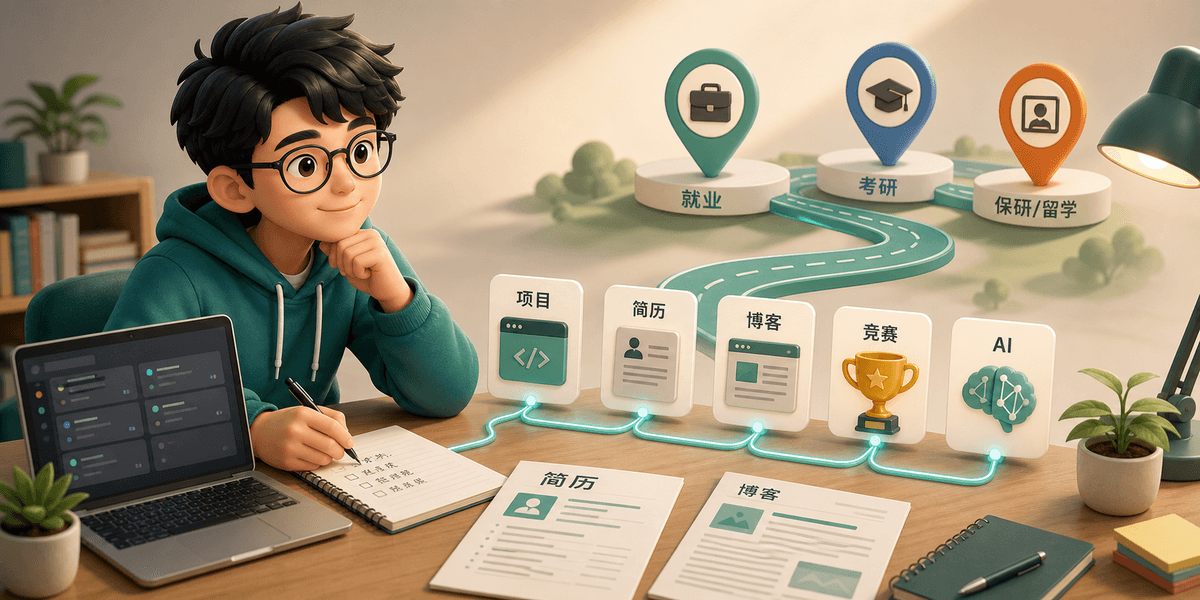
CS Students Should Start Career Planning in Year One
Students in computer-related majors often fall into a misunderstanding: career planning is something to think about in junior or senior year. Only when they start looking for internships do they realize they have no project worth showing. Only when they prepare a resume do they realize every experience looks like a course assignment. Only when they need to choose between graduate school, recommendation, and employment do they realize the previous years left too little evidence.
Career planning does not mean a first-year student must immediately decide what to do for life. It is more like doing one thing continuously throughout four years of college: turning learning, projects, expression, collaboration, and choices into reusable abilities and verifiable evidence.
Employment needs it. Graduate-school interviews need it. Research-lab applications and internships need it. Even later, when you change direction, city, or company, you will still use it.

Planning Early Does Not Narrow the Path
Many people become nervous when they hear “career planning.” They feel it means forcing themselves into an irreversible choice too early: backend, frontend, algorithms, embedded systems, security, graduate school, recommendation, or studying abroad?
That is not the right way to open the topic.
What a first-year student really needs is to build the ability to choose. You may not know the final path yet, but you should know roughly what each path requires, what you did each semester, and which efforts create value across multiple directions.
For example, doing the following in year one is not too early:
- Learn Git and GitHub, even if at first you only commit course assignments and exercises.
- Develop the habit of writing technical notes. Do not chase literary style; focus on explaining problems clearly.
- Study one main programming language seriously. Do not switch to the “hottest language” every month.
- Build mathematics, English, and computer-science foundations. Do not stare only at frameworks and tools.
- Try to build one complete small project. Even if it is simple, it should run, deploy, and be explainable.
- Observe different career directions: development, algorithms, testing, data, operations, security, product, and research. What does daily work actually look like?
These things will not narrow your path. They will give you more freedom later.
A typical counterexample is this: a student only chases course GPA in the first two years and touches nothing else. In junior year, they want an internship and discover they have no project. They want recommendation and discover their research experience is thin. They want graduate school and are not sure why. It is still possible to catch up then, but the pressure is much higher.
A better rhythm is: build foundations in year one, build projects in year two, seek internships, competitions, or research in year three, and make choices in year four based on evidence already accumulated. Planning is not a goal written on paper. It is having something visible to show every semester.
Stabilize the Foundation First
The most dangerous kind of busyness in computer science is surface busyness: learn one web framework today, watch a large-model tutorial tomorrow, install a cool development environment the day after, but still be unable to write a stable program or explain how a bug was located.
If you are still in the first or second year, fundamentals matter more than chasing trends.
The foundation can be split into five parts.
Programming ability. Do not only copy tutorials. At least be able to break down requirements, create a project, write tests, handle exceptions, read errors, and search documentation. You can choose Python, Java, C++, or JavaScript as your main language, but do not stop at syntax.
Computer-science fundamentals. Data structures, operating systems, computer networks, databases, and compilers may feel abstract, but they reappear in interviews, system design, performance optimization, and debugging. You do not need to become an expert in every course, but you cannot be hollow.
Engineering habits. Use Git. Write README files. Configure environments. Work with branches. Record issues. Add basic logging and tests. These may not receive much attention in class, but companies and labs care about them.
Communication ability. Many students are not weak technically, but cannot explain what they have done. Communication ability is not exaggeration. It is explaining background, problem, solution, result, and tradeoff clearly. Blogs, project docs, presentations, and interviews all train this.
English and search ability. A large amount of first-hand technical material is still in English. Reading official docs, paper abstracts, GitHub issues, and Stack Overflow answers is a practical advantage.
These things are less visible in the short term than “I learned a hot framework”, but they are worth more in the long term. Frameworks change. Foundations remain.
Present Yourself, Do Not Fake Yourself
“Packaging yourself” can sound utilitarian, and may even remind people of resume fraud. Useful presentation is not putting a filter over yourself. It is organizing what you have actually done into evidence that others can understand, verify, and trust.
The most common problem for students is not having no experience at all. It is that experience is scattered everywhere: course projects stay in local folders, competition code cannot run, experiment records exist only in chat history, articles read have no notes, and the resume is reduced to one sentence: “familiar with Java / Python / deep learning.”
That is a waste.

A healthy personal presentation system can have three parts.
Projects on GitHub or another code platform prove that you really wrote code. A project does not have to be large, but it should be complete. One installable, runnable project with README, screenshots, tests, or sample data is more convincing than ten half-finished repositories.
Technical blogs or learning notes prove that you can think and communicate. A blog does not need to be advanced. An environment setup, a bug investigation, a paper reproduction, or a course-project refactor can be valuable if it is concrete.
Competitions, internships, research, and open-source contributions prove that you can complete tasks under constraints. Competitions are not only awards. The process matters: what part you owned, what experiments you ran, what problems you hit, and what result you reached.
These three parts should connect to each other.
For example, if you did a course project, do not only submit it to the teacher. Clean the code into a repository, write a blog explaining the architecture, record the problems encountered, and write it into your resume as a project experience. The same task then changes from “homework” into a presentable asset.
How Polished Should a Student Project Be?
Many students ask: my project is simple. Will putting it on GitHub be embarrassing?
The answer is: simplicity is fine. Chaos is the problem.
A student project suitable for public display should at least have:
- A README explaining what problem the project solves and who it is for.
- One command that can run it, or clear running steps.
- Necessary screenshots, API examples, or a demo video.
- A reasonable directory structure, without config files hardcoding your local paths.
- If datasets, models, or third-party services are used, explain sources and limitations.
- If the project is incomplete, clearly state what is done and what remains instead of pretending it is perfect.
Do not fear showing immaturity. Student projects are not mature commercial systems. But an honest, complete, runnable small project is far stronger than an empty “Spring Boot management system” shell.
What Should a Blog Contain?
The weakest blog style is “today I learned X and felt rewarded.” That does not help your future self much.
A better template is:
What specific problem did I encounter?
What wrong assumptions did I make?
What references did I check?
How did I finally solve it?
What would I do differently next time?
If you write about WSL setup, do not only paste installation commands. Explain why Windows and Linux filesystem performance differs, why Docker is slow in certain directories, how to verify that the GPU is visible to WSL, and which commands reproduce the result.
If you write about a recommendation-system project, do not only say “implemented collaborative filtering.” Explain data cleaning, train/test split, cold start handling, why you chose Recall or NDCG, and the limitations of the result.
Such articles are notes in the short term and proof of ability in the long term.
AI Can Help, But It Cannot Grow for You
Students today have a tool previous generations did not: AI.
Use it well. Do not worship it, and do not reject it. AI is best at three things: lowering startup cost, speeding up feedback, and helping organize thoughts.
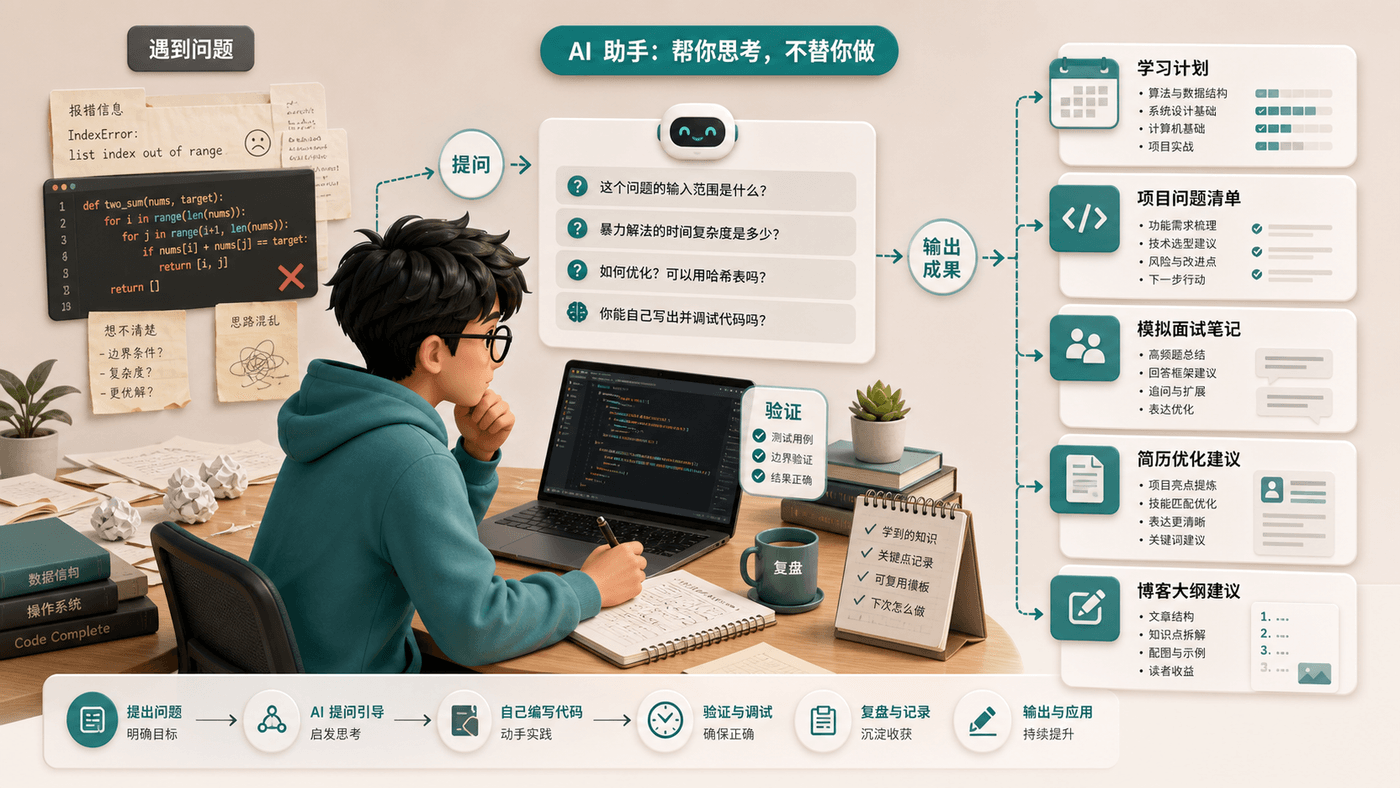
You can ask AI to explain code you do not understand, outline a learning path, simulate an interviewer asking project details, improve your project README, or point out vague expressions in your resume.
But keep one bottom line: verify what AI gives you.
If AI writes code, run it, read it, and modify it yourself.
If AI explains a concept, compare with textbooks or official documentation.
If AI revises your resume, do not add things you never did.
If AI generates a blog outline, the body still needs your own experience, code, screenshots, data, and judgment.
AI’s biggest benefit for students is not that it lets you learn less. It lets you enter practice faster.
Previously, environment setup might block you for a day. Now AI can help locate errors. Previously, you might not know how to split a project. Now AI can give several architecture options for you to choose from. Previously, no one gave resume feedback. Now AI can play interviewer and ask what the hard part of your project really was.
But one danger is obvious: AI creates the illusion of “I seem to understand.”
Understanding an AI answer is not the same as being able to do it. Copying code and making it run is not the same as maintaining it. Asking AI to generate a blog is not the same as having the corresponding experience.
So I recommend treating AI as a coach and sparring partner, not as someone taking the exam for you. After using AI, ask yourself:
If I had no AI, could I explain this to someone else?
If this code fails, could I locate the issue?
If an interviewer asks deeper questions about this project, can I explain the tradeoffs?
If yes, it has become your ability.
A Resume Is Not Written in the Last Week
Many students treat resumes as a last-minute job-search document. In late junior year or early senior year, they open a template and try to remember what they did. Then they realize the details are blurry: project scale, modules owned, performance metrics, competition ranking, experiment results, code links.
A resume should be maintained from year one. Not because you need to submit it in year one, but because it is a growth ledger.
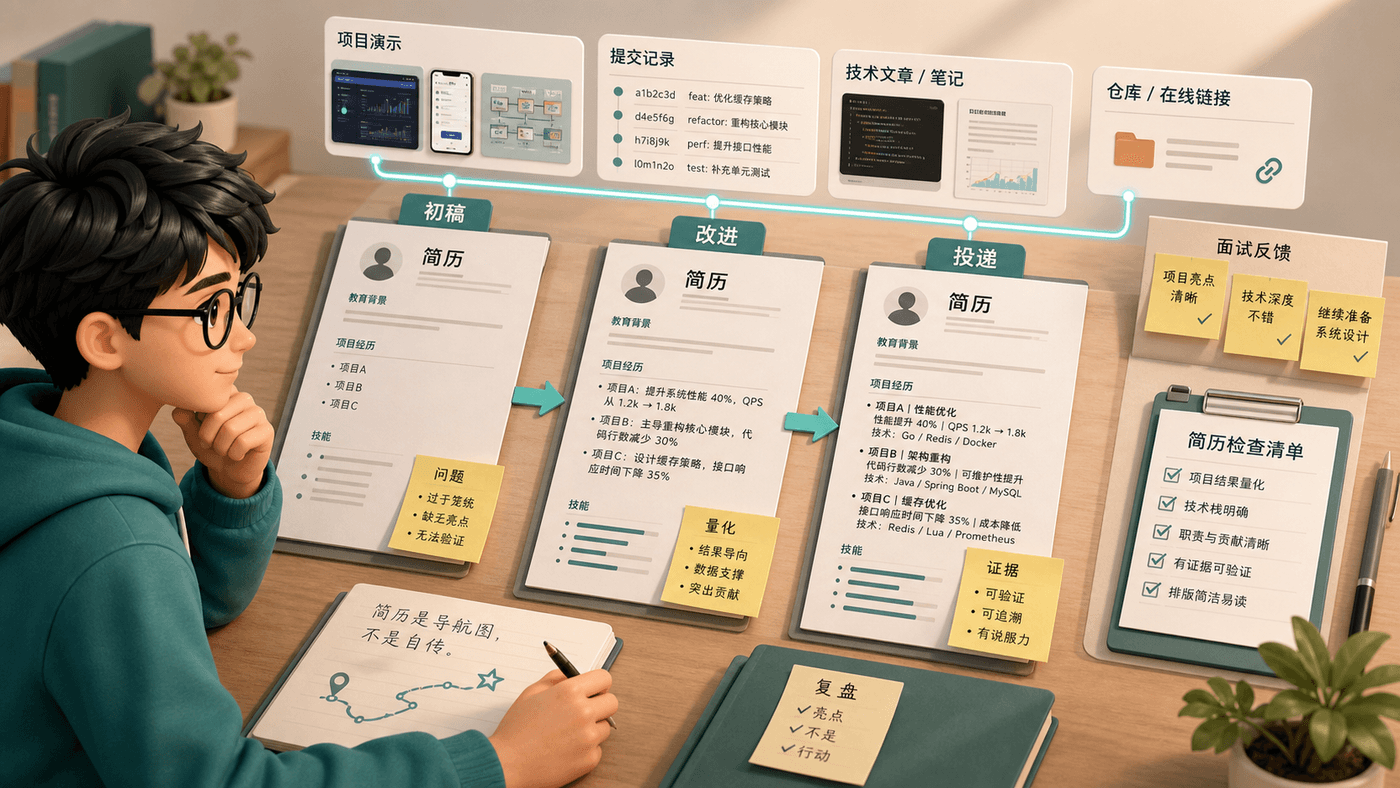
Update it once per semester, even if it looks empty. Emptiness is useful. It reminds you what to fill next.
An early resume may contain only:
- Core courses: data structures, programming, linear algebra.
- One course project: library system, crawler, small game, or data analysis.
- One learning-notes repository.
- One technical blog.
That is fine. The key is iteration.
In year two, add more complete projects, competitions, and open-source contributions. In year three, rewrite experiences closer to real job language.
The Real Purpose of a Resume
A resume is not an autobiography or a skill inventory. Its purpose is to let the reader quickly decide whether you are worth a conversation.
It should answer three questions:
What can you do?
What have you done?
What result did your work produce?
Many resumes say:
Familiar with Java, Spring Boot, MySQL, Redis, and microservice architecture.
This is not completely useless, but it is too empty. The interviewer cannot tell what you actually did.
A better way is to put skills into a project:
Responsible for product publishing, search, and order modules in a campus second-hand trading system. Implemented core APIs using Spring Boot + MySQL. Added pagination and indexes for product-list queries, reducing response time from about 1.8 seconds to under 300 ms on 100K test rows. Wrote deployment documentation and API examples. The project can be started locally with Docker Compose.
This is not perfect, but it has scenario, technology, responsibility, result, and verification.
If your project is simpler, write from the small details:
Implemented a course-grade analysis script in Python, including CSV cleaning, anomaly checks, and visual statistics. Replaced manual merging of four spreadsheets with one command that generates a report, and documented the process in a blog post.
This is much stronger than “familiar with Python data analysis.”
How to Keep Improving the Resume
I recommend maintaining three materials.
One is a complete experience archive. No page limit. Record projects, courses, competitions, experiments, blogs, and certificates. For each item, write time, background, your responsibility, tech stack, result, links, and verifiable materials.
One is the standard one-page resume. Use it for internships, campus recruiting, labs, or summer camps. It requires selection: include only what supports the current goal.
One is an interview-question draft. For each project on the resume, write likely follow-up questions in advance: why design it this way? What was the hardest problem? Where did the data come from? Did you test it? What if users increase? What did you own and what did teammates own?
These materials support each other. The archive preserves details, the resume supports applications, and the question draft supports interviews.
Employment, Graduate School, and Recommendation Share Many Efforts
Students often worry: I have not decided between employment, graduate school, or recommendation. Will these efforts be wasted?
Most of them will not.
Studying data structures, operating systems, and databases seriously is not wasted. Employment interviews use them, graduate entrance exams use them, and research coding uses them.
Building a complete project is not wasted. It helps resumes, recommendation interviews, and graduate-school interviews.
Writing blogs is not wasted. It trains expression and preserves review. Teachers, interviewers, and future colleagues can understand you more easily.
Participating in competitions is not wasted. Even without a major prize, the process forces you to search references, divide work, handle time pressure, and tune plans.
Learning to use AI and tools is not wasted. Whether you go to graduate school or work, you will face many unfamiliar problems.
What is more easily wasted is looking busy: collecting dozens of courses without finishing them, registering for many competitions without review, opening many repositories that cannot run, and filling resumes with technical terms without evidence.
The goal of career planning is not to bet on one correct answer. It is to make your effort transferable.
If you choose employment, you have projects, blogs, a resume, and interview materials.
If you choose graduate school, you have foundations and experiences to discuss.
If you seek recommendation, you have evidence beyond GPA.
If you change direction, you still have learning methods, communication ability, and engineering habits.
That is the value of planning.
What to Do by Year
In year one, do not rush into “advanced projects.” The most important task is to build a learning system. Choose a main language, study data structures seriously, learn Git, write small programs, and organize course assignments into reviewable repositories. You can start blogging, with topics based on real problems you encounter.
In year two, start building complete projects. Do not only make pages, and do not only make algorithm demos. Try to build something with data, APIs, deployment, and documentation. It can be a web app, data-analysis tool, mobile app, crawler system, game, small AI app, or experiment reproduction. The key is not how large the topic is, but whether you can explain it clearly.
In year three, move toward real opportunities. Internships, competitions, labs, and open-source contributions all work. Start putting projects into your resume and let others review them. Let classmates, teachers, seniors, and AI all ask hard questions. The worst thing at this stage is building behind closed doors.
Year four is about choice and delivery. For employment, focus on applications and interview review. For graduate exams, put your main energy into preparation, but do not completely drop projects and expression. For recommendation, organize materials, contact supervisors, and prepare interviews. Year four should not start from zero. It should turn the previous three years into something others can understand.
If you are already in year three or four when reading this, do not panic. Late start is still possible, but it requires focus. First organize existing experiences, choose the most valuable project, add documentation, README, and a blog, then revise the resume until it explains clearly. Do not try to create ten projects in one month.
A Few Often-Ignored Things
Career planning is not only about technology.
Find a real feedback source. It can be a teacher, senior student, internship colleague, open-source community, or interview. Do not work only inside your imagination for a long time. You need to know how the outside world evaluates your project, writing, and resume.
Do not ignore collaboration. Many student projects look like technical problems, but get stuck on collaboration: unclear requirements, no API agreement, code not merged, no documentation. These all matter in real work.
Watch information quality. Consume less anxiety content. Read job descriptions, strong resumes, open-source README files, school recommendation requirements, lab homepages, and previous experience posts. Anxiety does not create action. Specific information does.
Protect health and rhythm. Computer learning easily turns into late nights, but long-term sleep loss lowers efficiency. Planning is not filling every minute. It is giving each period a focus.
Do not overvalue short-term results. Failing to win one competition, failing one interview, or having nobody read one blog post is not failure. What matters is whether you reviewed it and turned the experience into something lasting.
A Monthly Checklist You Can Use Directly
If you do not know where to start, do a small monthly check:
Did I commit code this month? Does the code have a repository and README?
Did I write one technical note? Does it explain one concrete problem?
Did I read one official document, paper, or high-quality source repository?
Did I update my experience archive? Did I record project results and links?
Did I let someone else review my project, article, or resume?
Did I use AI to help myself learn, while personally verifying the result?
Do I understand more clearly which direction I like or dislike?
This checklist is not complicated. If you keep doing it for a year, you will be far ahead of students who only leave behind course assignments.
Do Not Turn Planning Into a Slogan
Career planning is useful not because it produces a beautiful plan document, but because every semester leaves behind something verifiable.
A runnable project.
A blog post that explains a real problem.
A competition review done seriously.
A resume that keeps improving.
A clearer judgment about direction.
These will not guarantee the best offer, nor guarantee graduate recommendation. But they reduce blank space at critical moments and give you more choices.
Four years in college are long, and also very fast. Starting career planning in year one is not about early anxiety. It is about avoiding last-minute storytelling later.
Real planning means what you did can remain, be explained, be verified, and continue to matter across different choices.
Follow ZiCode on WeChat
If this post was useful, you can follow later updates on WeChat as well.

X / Twitter
Follow @ax2_zicode
Faster technical notes, short thoughts, and new-post alerts are posted on X.