
AI World Cup Prediction Should Start With Probabilities
When the World Cup starts, prediction becomes a public sport. Who can win the title, who will upset a favorite, which traditional power will collapse in the group stage. Social media never lacks answers.
In recent years, there has been a new way to play: ask AI.
The problem is that many “AI predicts the World Cup” posts are still just asking a large language model to recall a list of strong teams and produce a confident-sounding conclusion. It may say one team has squad depth, another has an aging midfield, and another has championship pedigree. It reads smoothly, but that is not prediction. At best, it is pre-match chatter.
I prefer to treat World Cup prediction as a probability-engineering problem. It is not meant to answer “who will definitely win.” It should answer more honest questions: how likely is each side to win this match? How does a group’s qualification probability change? What are the chances that a team reaches the quarterfinals, semifinals, final, or wins the tournament? If the starting lineup changes, which probabilities should move and why?
This was written after the 2026 World Cup started. FIFA expanded this tournament to 48 teams and 104 matches, with 12 groups of four teams. The top two in each group plus the eight best third-place teams advance to the round of 32. The longer schedule creates more samples, more upset paths, and more ways for weak models to show their weakness.
Do Not Start by Asking AI Who Will Win
If you only ask “who will win the title,” it is not very interesting whether the answer is France, Argentina, Brazil, Spain, or England. Strong teams are strong. Guessing one correctly once does not prove that a model is good.
Better questions are:
How did a team’s 24% title probability come out?
Is its chance of losing to a weaker side underestimated?
How different is its knockout path if it finishes first or second in the group?
When the model predicted a 60% win probability in the past, did those teams really win about 60% of the time?
These questions are less noisy, but they are closer to the nature of prediction. Football is not chess. No team can push a single-match win probability to 95% in a meaningful World Cup context. A red card, penalty, goalkeeper performance, deflection, or controversial decision can change the result. Good World Cup prediction should output probabilities, not slogans.
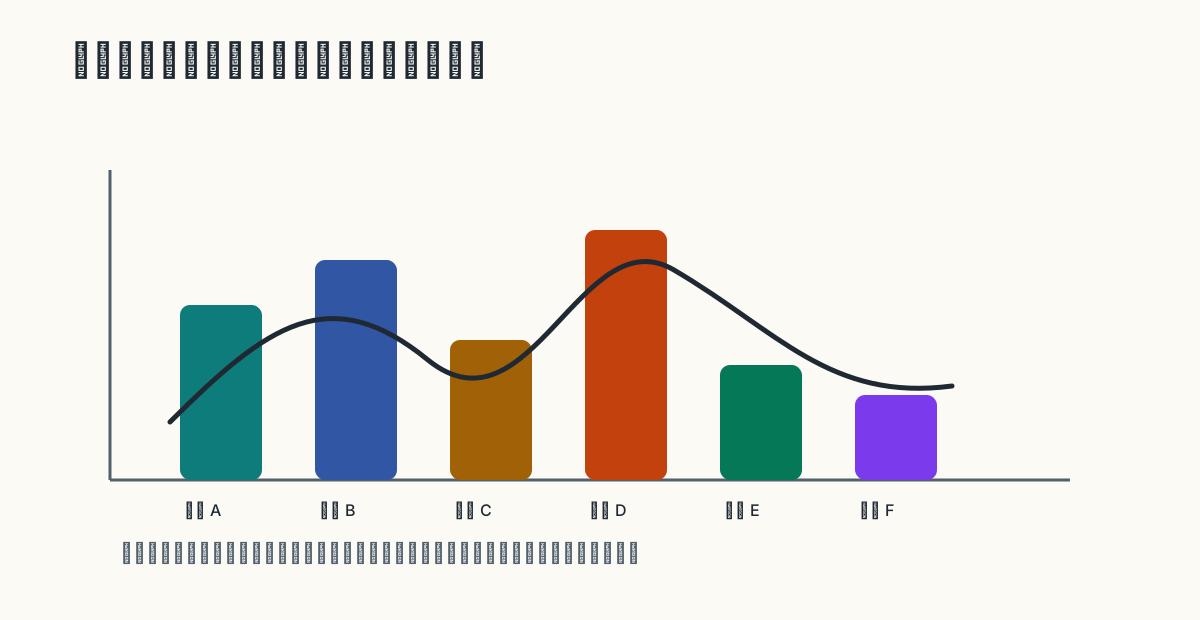
The team with the highest title probability may still only have a twenty-something or thirty-something percent chance. In other words, the strongest team failing to win does not automatically mean the model was wrong. The real test is whether its probabilities are calibrated over time.
Layer One: A Baseline That Does Not Pretend to Be Smart
The plainest starting point for World Cup prediction is team strength.
The most common tool here is Elo. Elo was not invented for football, but it works well in sports prediction: a team gains points when it wins and loses points when it loses; beating a stronger team is worth more; losing to a weaker team costs more; match importance, goal difference, and home advantage can be weighted.
Elo is useful because it is restrained. It does not need every player’s running distance or every match’s xG. Given enough international-match history, it gives each team a dynamic strength value. This is especially useful for national teams, because public detailed data is thinner than club football data, and matches are less frequent.
Elo also has blind spots. A new coach, injuries, suspensions, an aging golden generation, or a new player suddenly rising will not immediately appear in the historical rating. Pre-World Cup friendlies are tricky too: some teams play seriously, some test lineups, and some conserve energy. Treating all matches the same will bias the model.
So I would treat Elo as the chassis, not the destination. It answers “who is stronger over the long run.” Later layers need to add form, lineups, and tournament path.
Layer Two: Convert Strength Into Goal Probabilities
Football prediction is different from basketball prediction. Low scores are common, and randomness is large. A 1-0 and a 2-1 can contain a lot of luck. Predicting only win-draw-loss loses too much information. A common approach is to first predict how many goals each team will score, then aggregate all scorelines into win, draw, and loss probabilities.
The classic method is a Poisson goal model. It treats goals as sparse events. If a team’s expected goals in a match is 1.4, you can calculate the probability that it scores 0, 1, 2, or 3 goals. Each team has a goal distribution; combine the two distributions and you get a score matrix.
The Dixon-Coles model improves on this idea. It notices that low-score results such as 0-0, 1-0, 0-1, and 1-1 are not handled well by simple independent Poisson assumptions, so it adds a low-score correction. It also introduces time decay so recent matches matter more than distant ones.
These methods sound more old-school than “ask a large model,” but old-school does not mean outdated. They have one advantage: each step can be explained. Why one match has expected goals of 1.6 versus 0.9, why draw probability rises, and why low scores are corrected can all be inspected.
AI is better used here as augmentation rather than replacement. For example, a model can summarize injury news, identify lineup changes, and extract tactical style into structured features. The final probability calculation should still be handled by statistical models that can be backtested and calibrated.
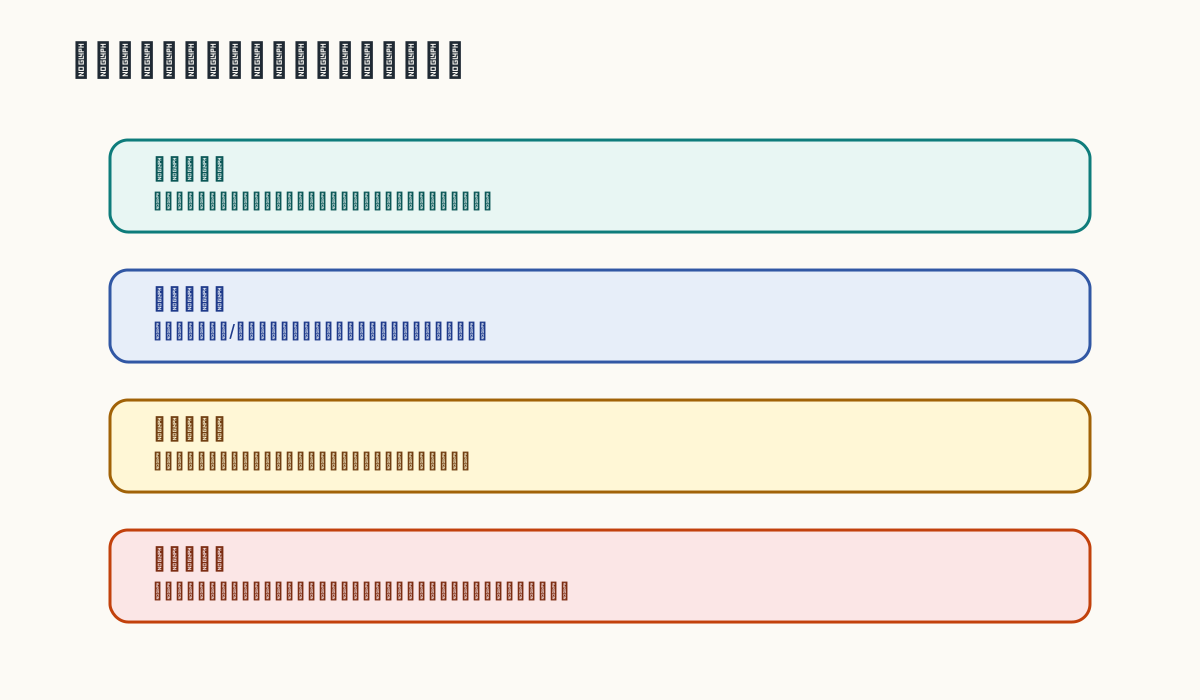
Layer Three: The World Cup Is a Path Problem
Single-match prediction is not enough. The World Cup is difficult because of paths.
The same team can face completely different worlds depending on whether it finishes first or second in its group. After expansion to 48 teams, third-place qualification makes the path even more complicated. A team may be very strong, but if its knockout bracket repeatedly runs into other strong teams, its title probability falls. Another team may be slightly weaker in single-match strength but have a more comfortable draw and a higher chance of reaching the quarterfinals.
So a useful model needs tournament simulation.
The method is not mysterious: assign win-draw-loss and score distributions for each group match; simulate group points, goal difference, goals scored, and ranking rules; determine the round of 32; then simulate knockout matches, including extra time and penalties. Repeat this many times, and you get each team’s probability of group qualification, quarterfinals, semifinals, final, and title.
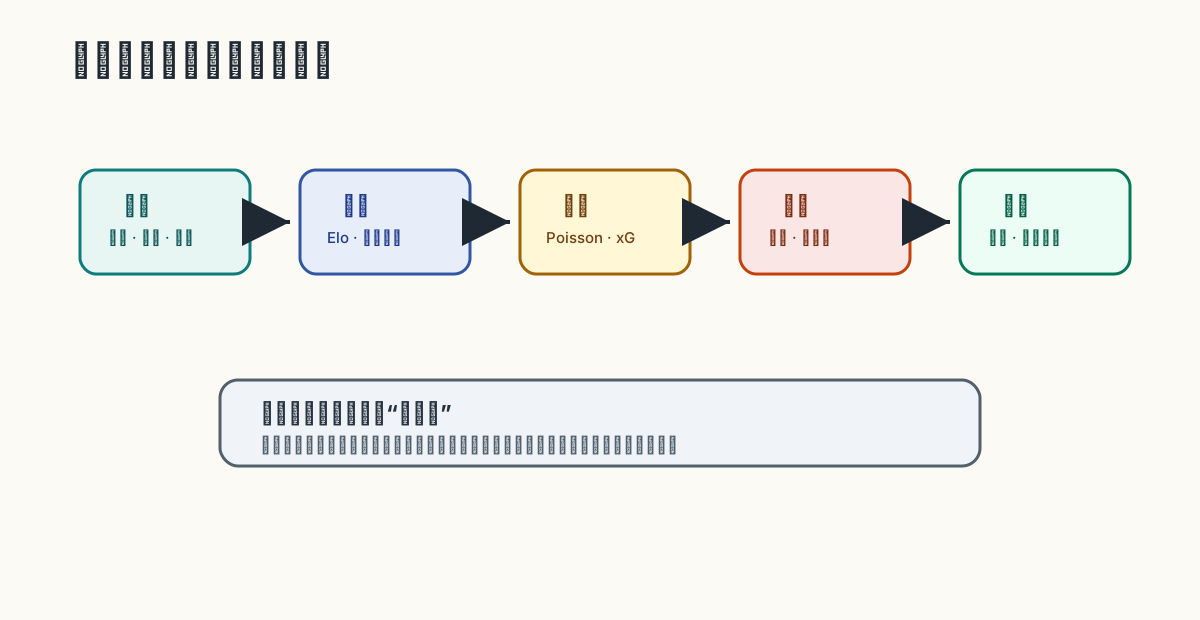
There is a counterintuitive point here: a team’s title probability is not the simple average of its match win probabilities. The path changes everything. The model is not only judging strength; it is also judging how hard the exam paper is.
Layer Four: Live Information Should Enter the Model, Not Take It Over
The most debatable part of World Cup prediction is live information.
Someone will say a team’s key player is injured, so historical data is meaningless. Someone else will say a coach is too conservative for knockout football. Another person will mention heat, travel, altitude, or home atmosphere.
All of these may be true.
The issue is that live information is easy to overinterpret. How many percentage points is an injury worth? From 52% down to 49%, or all the way to 40%? Without a scale, we are back to gut feeling.
A better approach is to separate live information into categories:
| Information | How to Use It |
|---|---|
| Confirmed starting lineup | Final pre-match update; usually the largest live input |
| Injuries and suspensions | Adjust attacking and defensive parameters by player importance |
| Rest days | Matters for fatigue and rotation in dense schedules |
| Venue and climate | Heat, altitude, and long travel should be considered separately |
| Tactical style | High press, low block, possession, and counterattack affect goal distributions |
| Penalty ability | Only affects knockout paths |
Large models can help in this layer. They are good at turning news, press conferences, injury reports, and coach interviews into structured summaries. But they should not directly output final win probability. Final probabilities should return to the same probability framework; otherwise every match will be dragged around by temporary narratives.
Backtesting Matters More Than Model Names
People like to ask whether to use random forests, XGBoost, neural networks, or large language models.
My view is: do not start with model names. In football prediction, an honest Elo + Poisson model, carefully backtested and calibrated, may be more reliable than a feature-heavy black box that has not been validated.
Backtesting should look at at least three things.
First, accuracy. Did the predicted winner actually win? This is intuitive but coarse, because it ignores probability.
Second, probability quality. When the model says a team has a 70% win probability, do such teams win about 70% of the time over the long run? If they often only win half the time, the model is overconfident.
Third, extreme cases. Mismatches, knockout matches, penalty shootouts, red cards, heat, and missing starters can all expose systematic bias.
Football does not have huge sample sizes, and the World Cup has even fewer. It happens every four years, and the tournament format changes. Training only on World Cup history can easily produce a system that memorizes the past but cannot predict the future. A more reasonable approach is to build a baseline from many international matches, then add World Cup-specific adjustments.
Odds Are Not the Answer, but They Are Useful for Calibration
World Cup prediction cannot avoid betting odds. Bookmaker odds are not pure true probabilities; they include risk control, public-flow bias, and margin. But it is also wrong to pretend they have no value. Mature market odds often aggregate a large amount of information.
A practical approach is to compare your model probabilities with market-implied probabilities.
If they are close, you may not have discovered anything new, but at least the model is not absurd.
If they differ a lot, do not rush to think you have found treasure. First ask: did you miss injury information? Did you calculate the tournament path wrong? Did the model underestimate draws? Is one team’s historical sample poor?
The valuable question is not “why am I different from the market?” It is “do I know why I am different?”
What a Prediction Report Should Look Like
If I were to build a World Cup prediction report, I would not put “Champion prediction: Team X” on the front page. I would show it in layers.
Start with the overview: title probability, final probability, semifinal probability. Make it clear that this is probability, not ranking.
Then show groups: qualification probability, first-place probability, and third-place-advance probability. This is where upsets are easiest to see.
Then show paths: if a team finishes first, who is it likely to face; if it finishes second, how does the path change? Fans like discussing “draw luck”; a model can quantify it.
Finally show single matches: win-draw-loss, expected goals, most likely scorelines, and key uncertainties. Single-match predictions should update with lineups and injuries, not stay frozen a week before kickoff.
Most importantly, the report should preserve uncertainty. Do not turn 57% into “locked.” The more honest the model is, the less exciting it may look in the short term, but the more trustworthy it becomes over time.
Where AI Actually Helps
AI is useful, but not as an oracle.
Its real value is in turning scattered information into model-ready inputs: fixtures, injuries, news, interviews, historical results, player form, and tactical labels. Traditional statistical models handle probabilities. Large models handle information organization and explanation. This division is more stable than using either side alone.
The system I would like to build looks roughly like this:
The data layer pulls results, fixtures, lineups, injuries, and odds every day.
The model layer maintains team strength, goal distributions, penalty tendencies, and path simulation.
The calibration layer continuously backtests and checks whether the model is overconfident.
The explanation layer translates probability changes into readable language: why one team’s title probability moved from 12% to 9%, whether because of injuries, path changes, or opponent updates.
Such a system may not let you guess the champion, but it can help you say far fewer useless things.
The Most Fascinating Part of World Cup Prediction
Predicting the World Cup is different from predicting many business metrics. Business metrics usually prefer stability. The World Cup is fascinating because of instability.
Strong teams lose. Weaker teams hold 0-0. Penalty shootouts compress four years of preparation into a few kicks. A model’s job is to put these uncertainties into a clearer framework, not pretend they do not exist.
So the best posture for using AI to predict the World Cup is not “I know the answer.” It is “I know the current possibilities and why they are distributed this way.”
That is less noisy than guessing a champion, but it is closer to football and closer to prediction.
References
- FIFA: 2026 World Cup new format
- FIFA: 2026 World Cup schedule, results, and stadiums
- World Football Elo Ratings: 2026 World Cup ratings
- Betfair Data Scientists: World Cup 2022 Elo Rating System Tutorial
- David Sheehan: Dixon-Coles and Time-Weighting
- Dixon and Coles: Modelling Association Football Scores and Inefficiencies in the Football Betting Market
Follow ZiCode on WeChat
If this post was useful, you can follow later updates on WeChat as well.

X / Twitter
Follow @ax2_zicode
Faster technical notes, short thoughts, and new-post alerts are posted on X.