2001: The Golden Age Inside Linux Discs
In 2000, the internet bubble burst.
Many stories suddenly cooled down. Portals could no longer talk only about growth. Startups began to count cash flow. Capital markets turned from excited to picky. Sentences like “everything will change once it goes online” became less useful than the year before.
But some things did not cool down.
Linux was one of them.
Around 2001, Linux in China had a very special heat. It was not directly facing the public like portal websites, nor standing at the center of capital markets like the internet bubble. It was more like a fire burning inside the technical community: distributions, discs, technical magazines, forums, mailing lists, training, domestic operating systems, servers, desktop environments, and open-source ideals all mixed together.
I had not yet truly entered a Linux company. That would happen after 2002.
But looking back, 2001 was a transition point.
The earlier foreshadowing was actually in 1995. I installed Slackware Linux on my own 386, bought a disc, and faced partitions, booting, configuration files, and a strange Unix-like world. At that time, I only felt that computers could have another shape. By 2001, this “another shape” had begun to become an industry and an ideal in China.
Discs, Magazines, and Distributions
Today, installing Linux usually means downloading an ISO, writing a USB drive, or choosing an image on a cloud server.
Around 2001, discs still mattered.
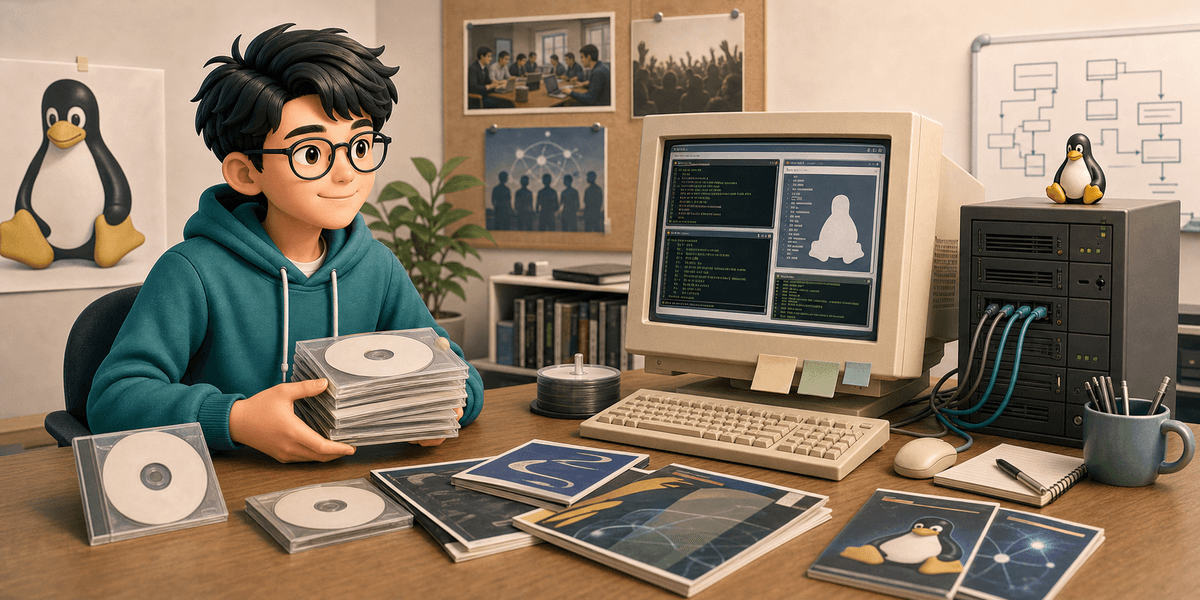
Technical magazines included discs. Bookstores sold distribution discs. Computer markets had all kinds of system discs. Red Hat, Debian, Slackware, Mandrake, SuSE, and some domestic distributions appeared repeatedly in articles, forums, and technical exchanges.
A disc was not only installation media. It was an object of the era.
When you got one, you would examine the packaging, read the version, study the kernel, desktop environment, and packages, and wonder whether installation would succeed this time. When installation finally succeeded and the screen showed a login prompt or graphical desktop, the feeling was completely different from today’s cloud instance starting in seconds.
It was slower and more ceremonial.
Many people encountered Linux then not because work required it, but out of curiosity: what exactly is this system? Why do so many people say it represents the future? Why are people willing to open source code? Why can a system be maintained by people around the world together?
These questions were technical and also a little idealistic.
That was the special smell of the Linux heat around 2001.
Those Domestic Linux Distributions
The golden age of domestic Linux was not only technical heat. It also carried the imagination of domestic software.
In that context, “operating system” was a heavy phrase. Windows almost dominated the personal-computer desktop, while enterprise servers and industry systems involved competition among UNIX, Windows NT, and Linux. For many people, building domestic Linux was not only making a distribution; it was also answering a larger question: could we have our own infrastructure software?
This was not an empty slogan. Around 2001, there were already several Chinese Linux distributions and companies people could name.
Red Flag Linux had the loudest voice among them. It had technical background from the Institute of Software, Chinese Academy of Sciences, was commercialized around 2000, and later stayed closely connected with domestic operating systems, government procurement, and industry applications. Its desktop, server, and embedded products were easy names for media to mention when writing about domestic Linux. Its later path was also representative: Red Flag Software entered liquidation in 2014, assets were later acquired, and the brand and product line continued in another form. It did not become the mass-market desktop system many imagined, but it pushed the phrase “domestic Linux” into high public visibility.
BluePoint Linux was more like a lively note around the millennium. BluePoint made many people notice the relationship between Chinese Linux desktops, localization, and capital markets. It released BluePoint Linux and also worked on Chinese-localized FreeBSD-related products. Looking back today, the most memorable part is not how far BluePoint went, but how early it encountered a hard problem: localizing a system and building a desktop is still far from replacing Windows. Chinese language, fonts, input methods, office documents, peripherals, and software ecosystems cannot be solved by merely translating menus.
Xteam Linux was another frequently mentioned name. Sources often describe it as one of the earlier complete Chinese Linux distributions, entering the market around 1999. Together with BluePoint and Red Flag, it formed one of the first memory sets of “domestic Linux distributions” for many old users. Later, the Xteam name gradually faded from mainstream view and remained more in old forums, disc collections, and retrospective articles.
There were also names that ordinary users mention less today, such as Co-Create Linux, Xinhua Linux, CS2C, Turbolinux, and later more community-flavored efforts such as Magic Linux. Their positions were not identical: some leaned toward government and enterprise markets, some toward education and training, some toward servers, some tried the desktop, and some were closer to community and hobbyist projects. Together, they show one thing: the domestic Linux heat of those years was not a single event, but a dense cluster of attempts.
These attempts later roughly split into several paths.
One path entered government, enterprise, and industry markets. The real demand for domestic operating systems did not disappear. It shifted from “let ordinary users replace Windows on the desktop” toward more specific industry applications, servers, office terminals, information-technology localization, and controllability.
One path remained in communities and people. Many distributions faded, but the people who learned kernels, drivers, Chinese environments, input methods, packaging, installers, desktop environments, and server configuration later spread into internet companies, infrastructure software companies, cloud computing companies, and system-engineering teams.
Another path became a lesson: building an operating system is not building an installation disc, nor translating an interface into Chinese. It requires hardware adaptation, application ecosystem, developer ecosystem, business model, customer support, and long-term investment. If any link breaks, the distribution quickly becomes a historical name.
So judging domestic Linux around 2001 only by “who survived” is too crude. A more accurate description is that it was an early collective training ground for infrastructure software. Many brands did not become final answers, but they helped a generation of programmers seriously understand system software, open-source collaboration, and the difficulty of domestic infrastructure software.
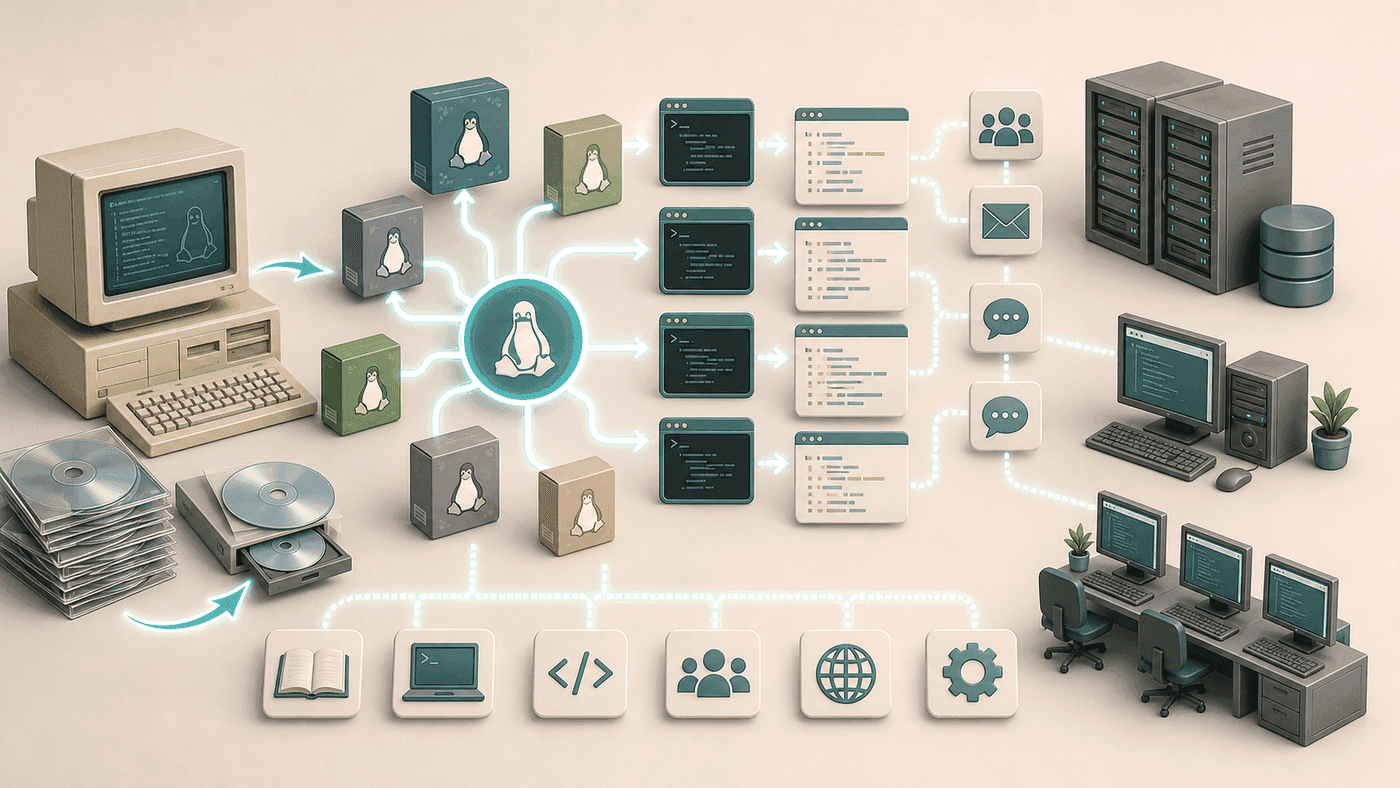
From installation discs and personal computers to distributions, communities, and servers, Linux spread like a slowly expanding net. The image is a period-inspired illustration.
Open Source Was More Than Free Software
Many people first heard of Linux through “free.”
That was attractive. No operating-system license fee, freely installable packages, visible source code, and lots of community tools. For students and young programmers, it was very tempting.
But the truly important part of Linux was not simply that it was free of charge.
It showed that software could be produced another way.
Not by one company writing behind closed doors and selling to users, but by a kernel, many tools, various distributions, countless maintainers, community discussions, patches, mailing lists, documentation, and arguments forming a system together. It was not necessarily neat, friendly, or suitable for everyone, but it was open, learnable, and modifiable.
For programmers, this openness was especially meaningful.
You were not only a system user. You could also be a reader, modifier, and contributor. Even if you never submitted a patch, once you could read configuration files, compile software, search source code, and understand the boot process, your relationship with the system had already changed.
Windows desktop application development taught people how software is delivered to users.
Linux taught people how systems are constructed.
These two kinds of training are very different.
The former emphasizes interface, tools, and delivery efficiency. The latter emphasizes structure, text, commands, permissions, processes, filesystems, and networks. A programmer who experiences both sees the software world in a more three-dimensional way.
From Desktop to Server
Around 2001, many people cared about the Linux desktop.
GNOME, KDE, window managers, Chinese input, fonts, office software, browsers, and printer drivers were common desktop Linux topics. People hoped Linux could replace Windows and that ordinary users could use it.
But what truly won at scale first was the server.
That is not surprising.
Servers do not require every ordinary user to adapt to a new desktop, nor do they need to support every peripheral and office habit. They value stability, networking capability, scripting, remote management, cost, and controllability. Linux had natural advantages there.
Many years later, internet-company servers, cloud computing, containers, Kubernetes, AI training, and inference environments all ran heavily on Linux. Today, even a programmer who does not use a Linux desktop can hardly avoid Linux completely.
In 2001, this path had not fully unfolded.
But the direction was visible.
When you typed commands in a terminal, configured networking, started services, checked logs, compiled kernels or packages, you were already learning the grammar of future system engineering.
Those things would reappear later on servers, in data centers, on cloud platforms, and on AI machines.
Why It Did Not Develop as Imagined
Of course, we should not romanticize Linux too much.
It was hard to use, and it was truly hard to install.
Hardware drivers might not be supported. Chinese environments required effort. Fonts looked poor. Office software had compatibility problems. Graphical desktops were unstable. Documentation was incomplete. When problems happened, you often had to investigate yourself. For ordinary users, using Linux as a daily desktop had a high barrier.
That is why Linux desktop adoption long failed to meet many early expectations.
Technical people easily underestimate the cost of “usable.”
A system that can run does not mean ordinary people want to use it. A theoretically existing feature does not mean users can finish work smoothly. Open-source software does not automatically create an ecosystem. Desktop systems are especially cruel because they face the most trivial, complex, impatient daily usage.
Domestic Linux also had a more realistic problem: the commercial loop was too hard.
Personal users were not used to paying for operating systems. Enterprise customers willing to pay often did not pay for “the system itself”, but for stable operation, hardware adaptation, troubleshooting, and continuous support. For distribution vendors, this meant supporting sales, implementation, service, and adaptation teams in addition to R&D. But the desktop market was locked by the Windows ecosystem, while the server market had to face mature routes such as Red Hat, SuSE, and Debian. The ideal was large, but revenue did not necessarily follow.
That is why many early domestic Linux distributions later became quieter. It was not because they had no value, but because operating systems are too heavy: technology, ecosystem, channels, policy, and commercialization must all work together. Any shortcoming becomes larger over time.
But difficulty does not erase value.
Linux did not defeat Windows on the desktop the way many hoped, but it changed the world on servers and infrastructure. Open source did not make every ordinary user a contributor, but it changed how the entire software industry collaborates.
This is a common mismatch in technology history.
A technology may not win in the place where people first expected it to win, but it may win much more thoroughly in another scenario.
Technical Communities Became Important
Around 2001, technical communities became increasingly important to programmers.
Forums, mailing lists, newsgroups, technical sites, and magazine columns were learning entrances. When you hit a problem, you searched, asked, and read configuration files and command output posted by others. Much knowledge did not come from formal textbooks, but from fragments of community experience.
This connects naturally to later Stack Overflow, GitHub, blogs, public accounts, knowledge communities, and open-source communities.
Programmers have never learned only from classrooms.
Especially for a system like Linux, many things require hands-on work, searching references, and seeing how others solved problems. You slowly form a habit: when you meet a problem, first read logs, then check documentation, then search the error, then try configuration, then return to understand the principle.
This habit lasts a long time.
Later, whether doing servers, operations, backend, big data, cloud native, or AI deployment, this problem-solving posture remains essential.
Linux taught people more than commands.
It taught people a posture toward complex systems.
From Slackware to the Next Career Stage
When I installed Slackware on a 386 in 1995, I did not know that it would connect to my later career path.
At the time, it was just curiosity.
By 2001, Linux was becoming hotter in China, and I started to realize more clearly that it was not an isolated technical interest. It was a real industry line. Later, in 2002, I would enter a Linux company and stay there until 2009. During that period, I would meet many colleagues from top schools such as Tsinghua and Peking University, and encounter well-known people in China’s Linux industry. Richard Stallman was later received by that company, which was more like an intersection between the free software movement and China’s open-source community of that era, not a personal experience of mine.
So this 2001 essay is a bridge.
Behind it is the Slackware disc from 1995.
Ahead of it is the Linux world that began for me in 2002.
Sometimes a person’s technical route does not suddenly turn. An early interest buried years before reappears at the right time.
Linux was like that for me.
The Next Year, Entering the Linux World
In 2001, Linux was still a lively direction.
In 2002, it became my job.
After truly entering a Linux company, things became much more complicated than discs, magazines, and technical ideals. There were excellent people, open-source ideals, commercialization pressure, and hard problems that domestic infrastructure software had to face in reality.
The next essay is about entering the Linux world.
2001 IT Timeline
- Linux kernel 2.4 was released. Linux 2.4 was released in early 2001 and strengthened capabilities important to enterprise and server scenarios. Linux continued moving from technical enthusiasts and early server use toward more mature infrastructure.
- Wikipedia launched. In January 2001, Wikipedia appeared. It brought open collaboration into knowledge production and became one of the most important public knowledge projects on the internet.
- Mac OS X 10.0 was released. In March 2001, Apple released Mac OS X 10.0. Based on the NeXT technology line, it combined a Unix-like foundation with a graphical desktop, laying the foundation for later macOS and Apple’s ecosystem.
- Windows XP was released. In October 2001, Windows XP was released. It later became one of the longest-used and most memorable Windows versions, representing a relatively stable stage of the personal-computer desktop.
- iPod was released. Apple released the first iPod in 2001. It began as a music player, but became an important node in Apple’s consumer-electronics transition and accumulated product and ecosystem capability for the later iPhone era.
- The Agile Manifesto was published. In 2001, the Manifesto for Agile Software Development appeared. It responded to rigidity and inefficiency in traditional software processes and later deeply influenced project management, product iteration, and software-team collaboration.
- Domestic Linux and open-source heat continued to rise. Around 2001, names related to domestic Linux such as Red Flag, BluePoint, Xteam, Co-Create, Xinhua, and CS2C continued to appear. Technical communities, training, distributions, and server applications were all active. Though the later path was uneven, it provided important system-software training for a generation of domestic programmers.
References
- The Linux Kernel Archives
- Wikipedia: History of Wikipedia
- Mac OS X 10.0 background
- Windows XP background
- iPod background
- Manifesto for Agile Software Development
- Slackware Linux Project: General Information
- Red Flag Linux background
- BluePoint Linux retrospective
- History of domestic Linux distribution exploration
- Xteam Linux historical materials
- Chinese Linux distribution collection around the millennium
Follow ZiCode on WeChat
If this post was useful, you can follow later updates on WeChat as well.

X / Twitter
Follow @ax2_zicode
Faster technical notes, short thoughts, and new-post alerts are posted on X.

More in this column
- 2005: Software Began to Live on the Web
- 2004: Languages Became a Toolbox
- 2003: Linux Met a Legal Shadow
- 2002: Linux Learned How to Do Business
- 2000: The Bubble Burst, the Net Stayed
- 1999: The First Socket Into Production
- 1998: The Butterfly Landed on a Form
- 1997: The Butterfly That Flew Through the Browser War