
Quant Trading for Programmers 18: Paper Trading Needs Risk Checks Too
Quant Trading for Programmers 18: Paper Trading Needs Risk Checks Too
Paper trading does not place real orders, but it still needs risk controls.
The reason is simple: the point of paper trading is not to let a strategy run freely. It is to expose risky account-level behavior before real trading.
First Risk Rules
Article 18 adds app/paper_risk.py and starts with three checks:
- Whether total exposure is too high.
- Whether the cash buffer is too low.
- Whether a single-stock weight exceeds the limit.
Risk control here does not predict drawdowns. It constrains account behavior. Common risk metrics can start from three categories: exposure, concentration, and liquidity. This article implements exposure and concentration first. Liquidity is left for later when volume, turnover, and suspended-status data are connected.
Risk Report
The result is not a boolean. It is PaperRiskReport:
@dataclass(frozen=True)
class PaperRiskReport:
    passed: bool
    severity: str
    violations: tuple[PaperRiskViolation, ...]
severity currently has three values: ok, warning, and blocker. Later notifications can distinguish ordinary hints from risks that should block execution.
Why Keep Violations
Each violation contains code, message, value, limit, severity, and an optional symbol.
That means the risk check does not just say “failed.” It explains which rule failed, what the current value is, and what the limit is.
PaperRiskViolation(
    code="position_too_large",
    message="Single-stock position weight is too high",
    value=0.72,
    limit=0.35,
    severity="blocker",
    symbol="000001.SZ",
)
This structure can later go directly into daily reports, Lark messages, or a risk dashboard.
Current Mainline Integrated Run
The paper-flow example sends the snapshot from article 17 into risk checks:
uv run python -m scripts.chapter_examples paper-flowArticle 18 output:
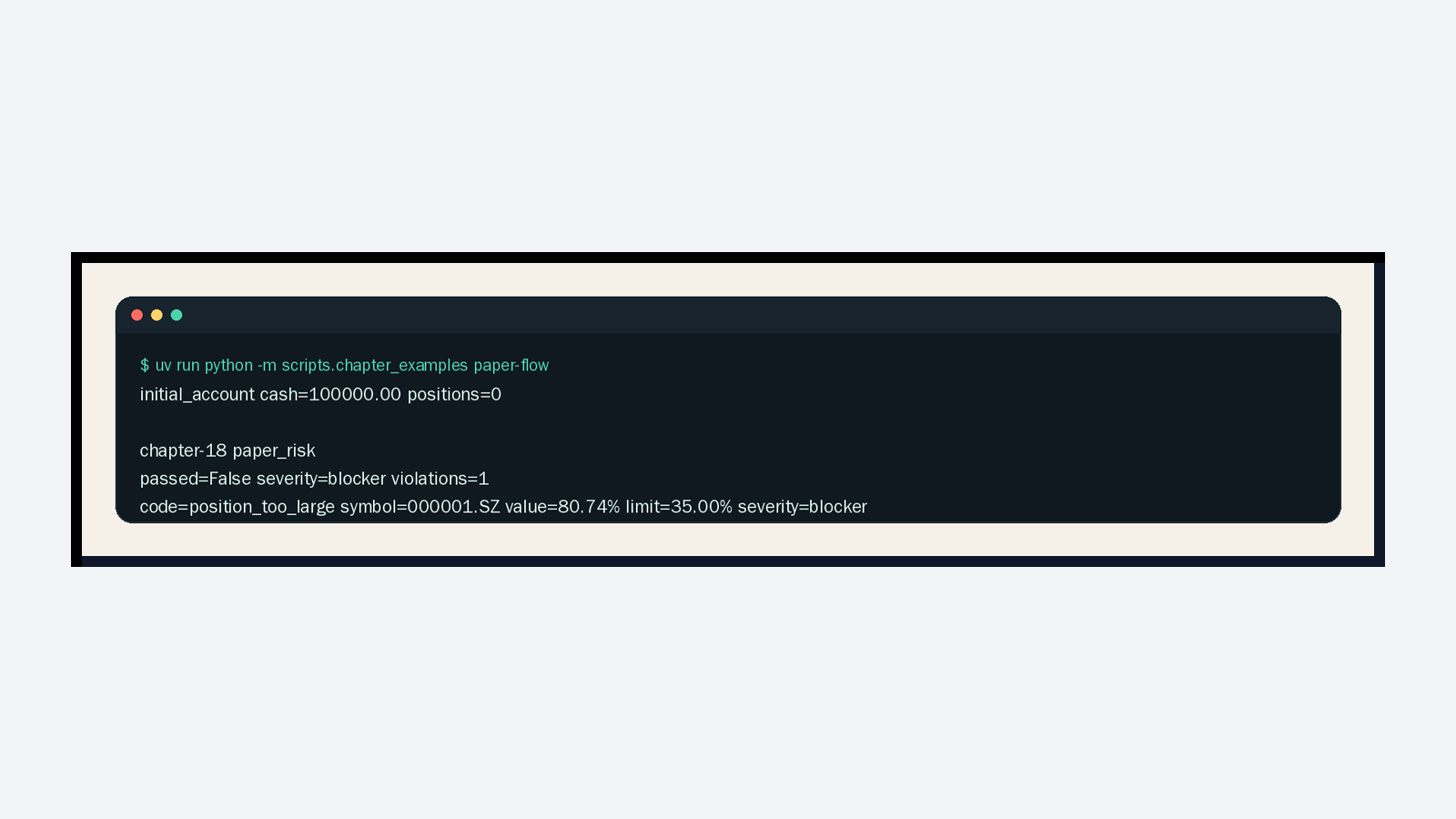
In this sample, the single-stock weight is 80.74%, exceeding the 35% limit, so the risk result is blocker. This does not mean 000001.SZ cannot be bought. It means the paper-trading account is too concentrated. Risk checks focus on account structure, not on an opinion about a single stock.
Chapter Update And Repository
This chapter adds:
app/paper_risk.py.- Total exposure, cash buffer, and single-stock weight checks.
PaperRiskReportand structured violations.tests/test_paper_risk.py, covering passing checks, low cash, single-stock limit breaches, and total exposure breaches.- A real current-mainline screenshot for the integrated risk-check example.
- Context for exposure, concentration, and liquidity as three risk-control categories.
Repository:
https://github.com/ax2/zi-quant-platformCode for this chapter:
git clone https://github.com/ax2/zi-quant-platform.git
cd zi-quant-platform
git checkout chapter-18
uv sync --extra dev
uv run pytest tests/test_paper_risk.py
Chapter 18 is commit 5b381f3, tagged as chapter-18.
Summary
Risk controls should not appear only right before real trading.
Article 18 connects paper-trading account snapshots to risk checks and outputs readable, testable violation reports. The next article turns target weights into rebalance plans, moving strategy suggestions into the planning layer before execution.
Follow ZiCode on WeChat
If this post was useful, you can follow later updates on WeChat as well.

X / Twitter
Follow @ax2_zicode
Faster technical notes, short thoughts, and new-post alerts are posted on X.

More in this column
- Quant Trading for Programmers 22: Save Daily Paper-Trading Review Records
- Quant Trading for Programmers 21: Compress Paper-Trading Results Into A Recommendation Summary
- Quant Trading for Programmers 20: Generate Paper-Trading Daily Reports And Alert Summaries
- Quant Trading for Programmers 19: Generate Rebalance Plans From Target Weights
- Quant Trading for Programmers 17: Generate Paper-Trading Account Snapshots
- Quant Trading for Programmers 16: Start With A Clear Paper-Trading Ledger
- Quant Trading for Programmers 15: Strategy Promotion Needs A Gate
- Quant Trading for Programmers 14: Save Strategy Candidates As Experiment Records