
Quant Trading for Programmers 19: Generate Rebalance Plans From Target Weights
Quant Trading for Programmers 19: Generate Rebalance Plans From Target Weights
One easy mistake in paper trading is treating a “strategy target” as an “account execution.”
Article 19 deliberately adds one layer between them: the rebalance plan. It only gives buy and sell suggestions. It does not directly modify account state.
Inputs To A Rebalance Plan
Chapter 19 adds app/rebalance_plan.py.
Inputs include:
- Current paper-trading account.
- Latest prices.
- Target weights.
- Minimum rebalance value.
Target weights can come from many places: equal-weight portfolios, factor-score rankings, risk budgets, manually specified whitelists, or more complex portfolio optimization later. No matter where they come from, they should become a rebalance plan before reaching the account layer. The strategy layer expresses “how much weight I want”; the account layer handles prices, board lots, minimum trade value, and risk controls.
Output Buy And Sell Suggestions
The output object is RebalancePlan, which contains a set of RebalanceOrderPlan entries:
@dataclass(frozen=True)
class RebalanceOrderPlan:
    symbol: str
    side: str
    shares: int
    price: float
    target_weight: float
    current_weight: float
    delta_value: float
It keeps current weight, target weight, and delta value so later explanations can show why a buy or sell is suggested.
Why Not Place Orders Directly
A rebalance plan is not an executor.
It does not deduct cash, change positions, or pretend an order was filled. In a real system, the plan still needs risk checks, manual confirmation, tradability checks, and execution matching. Even in paper trading, separating plan from execution reduces a lot of debugging cost.
A-Share Board-Lot Constraint
The plan function rounds shares down to board lots of 100:
def _lot_shares(raw_shares: float) -> int:
    lots = int(abs(raw_shares) // 100)
    return lots * 100
This stays consistent with the trading rules from article 4. If odd-lot selling or finer trading rules need to be supported later, this layer can be extended.
Current Mainline Integrated Run
After risk controls find excessive single-stock concentration, paper-flow continues by generating a rebalance plan from target weights:
uv run python -m scripts.chapter_examples paper-flowReal output:
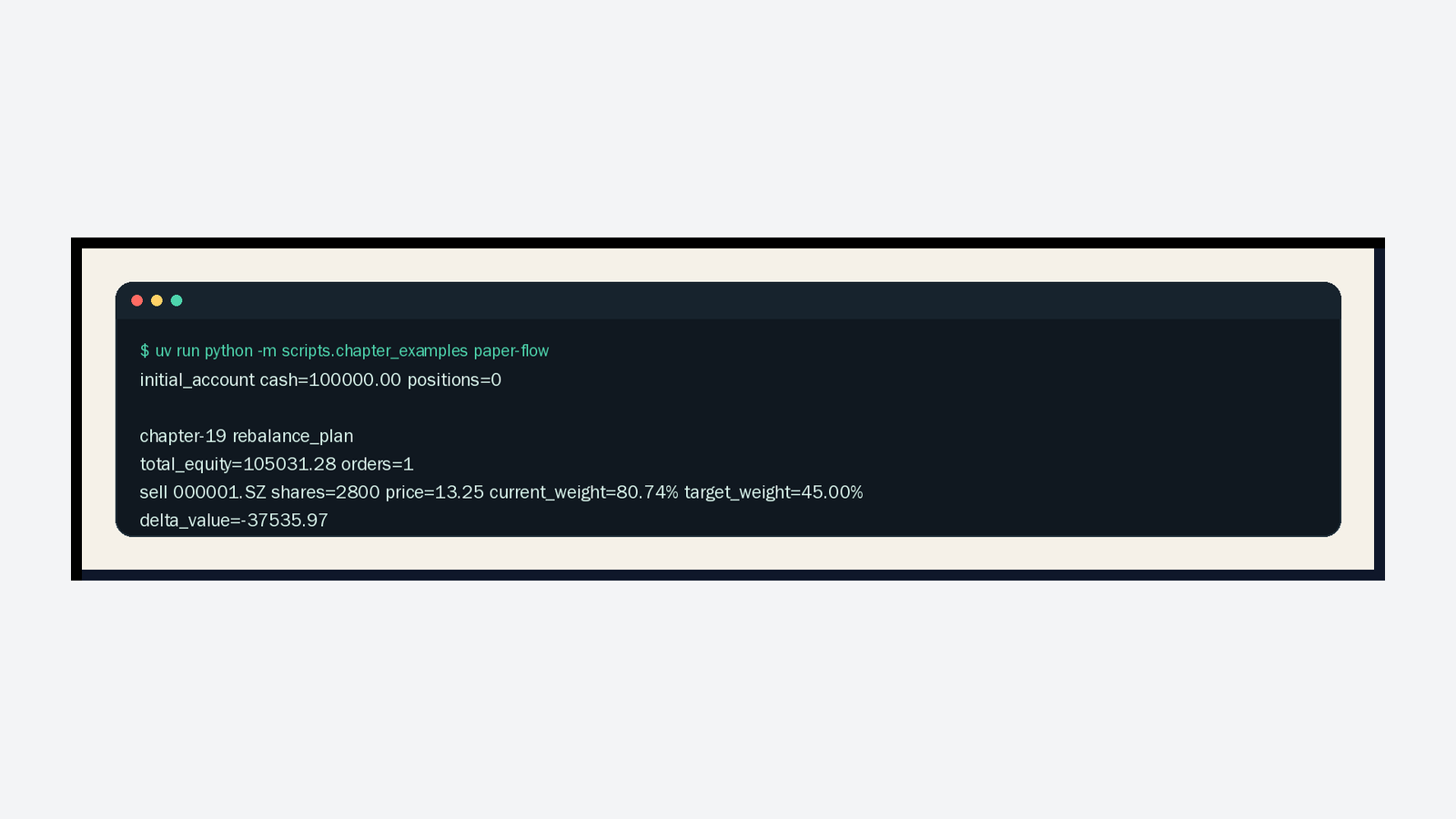
The current position weight is 80.74%, and the target weight is 45.00%, so the plan suggests selling 2800 shares. This is still only a plan. It does not directly modify the account. A later execution layer must still check available position, price, fees, and risk status.
Chapter Update And Repository
This chapter adds:
app/rebalance_plan.py.- Rebalance plans based on current weights and target weights.
- Minimum rebalance value filtering, missing-price skips, and A-share board-lot constraints.
tests/test_rebalance_plan.py, covering buy/sell suggestions and small-change skips.- A real current-mainline screenshot for the rebalance-plan integrated example.
- Context on target-weight sources and the responsibility boundary between strategy and account layers.
Repository:
https://github.com/ax2/zi-quant-platformCode for this chapter:
git clone https://github.com/ax2/zi-quant-platform.git
cd zi-quant-platform
git checkout chapter-19
uv sync --extra dev
uv run pytest tests/test_rebalance_plan.py
Chapter 19 is commit b655c37, tagged as chapter-19.
Summary
Strategy targets should not be treated as account actions directly.
Article 19 converts target weights into explainable, testable, not-yet-executed rebalance plans. The next article combines account snapshots, risk reports, and rebalance plans into one paper-trading daily report.
Follow ZiCode on WeChat
If this post was useful, you can follow later updates on WeChat as well.

X / Twitter
Follow @ax2_zicode
Faster technical notes, short thoughts, and new-post alerts are posted on X.

More in this column
- Quant Trading for Programmers 23: Link The Daily Paper-Trading Flow
- Quant Trading for Programmers 22: Save Daily Paper-Trading Review Records
- Quant Trading for Programmers 21: Compress Paper-Trading Results Into A Recommendation Summary
- Quant Trading for Programmers 20: Generate Paper-Trading Daily Reports And Alert Summaries
- Quant Trading for Programmers 18: Paper Trading Needs Risk Checks Too
- Quant Trading for Programmers 17: Generate Paper-Trading Account Snapshots
- Quant Trading for Programmers 16: Start With A Clear Paper-Trading Ledger
- Quant Trading for Programmers 15: Strategy Promotion Needs A Gate