
Quant Trading for Programmers 27: Record Paper-Trading Daily Reports In Files
Quant Trading for Programmers 27: Record Paper-Trading Daily Reports In Files
Article 26 abstracted notification channels. Now the system needs one concrete implementation that really runs.
Article 27 starts with a file-based channel: write daily report delivery records into JSONL. It is not the final notification solution, but it is very useful for local debugging and test replay.
Why Write Files First
Real notification platforms bring network calls, authentication, rate limits, and configuration.
All of that matters, but it is not the most important problem at this point. First, we need to prove that the daily flow can produce a report, the channel can accept it, and the send result can be saved.
JSONL Delivery Records
Chapter 27 adds app/file_notifications.py.
FileNotificationChannel writes each send action as one JSON line:
channel = FileNotificationChannel(path=Path("data/paper-alerts.jsonl"))
receipt = send_paper_alert(channel, message, destination="paper-daily", sent_at=now)
Each line contains the channel, acceptance status, destination, title, send time, severity, body, and error information.
Why Not CSV
The daily report body may naturally contain line breaks. CSV can handle that, but JSONL is easier to read and append.
The advantage of JSONL is that each line is a complete record. Later it can be read line by line, and command-line tools can inspect it quickly.
It also has an engineering advantage: append writes are naturally suitable for local audit logs. Even if the program exits halfway, already-written lines will not become unreadable just because a large JSON array was not closed.
Current Integrated Run
Continue running the same command:
uv run python -m scripts.chapter_examples paper-notifyThe file channel writes the daily report into paper-alerts.jsonl, and the example command then reads it back through read_file_notifications():
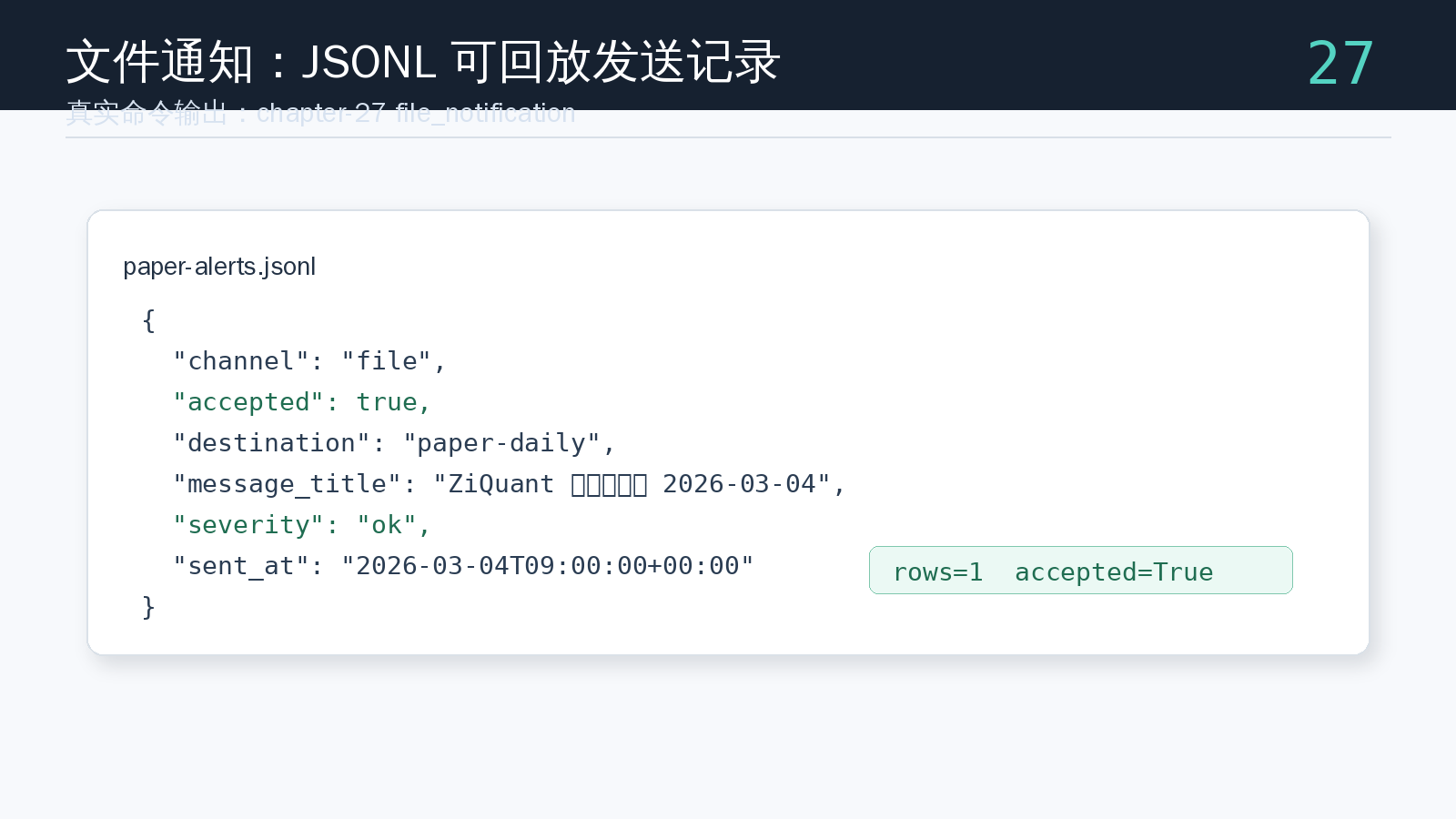
The screenshot keeps the core fields from one JSONL line. When Lark or email is connected later, the receipt structure can stay similar. Only the channel name and external-platform fields need to change.
Chapter Update And Repository
This chapter adds:
app/file_notifications.py.- A file-based notification channel.
- Append-only JSONL delivery records.
read_file_notifications()for reading records back.- An integrated
paper-notifyexample showing daily report delivery, JSONL records, and read-back output. - Context on using JSONL as an append-only audit log.
tests/test_file_notifications.py, covering valid sends, invalid sends, and missing-file reads.
Repository:
https://github.com/ax2/zi-quant-platformCode for this chapter:
git clone https://github.com/ax2/zi-quant-platform.git
cd zi-quant-platform
git checkout chapter-27
uv sync --extra dev
uv run pytest tests/test_file_notifications.py
Chapter 27 is commit 5191340, tagged as chapter-27.
Summary
The file-based channel makes notification delivery verifiable first.
Article 27 does not connect any external platform, but it can already save daily report delivery records. The next article continues splitting boundaries by abstracting price inputs in the daily flow.
Follow ZiCode on WeChat
If this post was useful, you can follow later updates on WeChat as well.

X / Twitter
Follow @ax2_zicode
Faster technical notes, short thoughts, and new-post alerts are posted on X.

More in this column
- Quant Trading for Programmers 31: Add A Run Window To Daily Jobs
- Quant Trading for Programmers 30: Generate A Daily Run Health Report
- Quant Trading for Programmers 29: Generate Target Weights From A Candidate List
- Quant Trading for Programmers 28: Abstract Price Inputs Into Price Providers
- Quant Trading for Programmers 26: Abstract Notification Channels First
- Quant Trading for Programmers 25: Add Production Checks To Paper Trading
- Quant Trading for Programmers 24: Persist Paper-Trading Account State
- Quant Trading for Programmers 23: Link The Daily Paper-Trading Flow